Change Language :
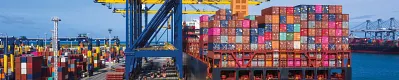
Shore power at the container terminal
Container terminals are facing the challenge of reconciling increasing demands for emission reduction and shore power supply with efficient terminal operation.
Different ship sizes, variable berthing positions and the requirements of IEC 80005-1 place high technical and operational demands on the system.
Find out what challenges characterise modern projects and how flexible solutions enable a secure and future-proof ship connection.
Key data on shore power for container terminals

7.5MVA

6.6kV

16kA/s

2 connectors
Shore power in practice: The iMSPO in the port of Hamburg
Container terminals have different requirements for the integration of shore power. Limited space on the quay edge, existing terminal infrastructure such as bollards, fender systems, rescue ladders, flood protection systems, and operational processes usually require the development of individual solutions. With the igus Mobile Shore Power Outlet (iMSPO), various installation options are available that can be flexibly adapted to the respective individual conditions. Since there is no standard solution, our engineering team will be happy to support you with the planning.
This video shows shore power projects that have already been implemented in the Port of Hamburg and illustrates how the different requirements of the individual container terminals were successfully taken into account. Depending on the terminal, different integration concepts were used. From assembly on the front of the quay wall to elevated solutions. Today, igus mobile shore power systems are in daily operation, enabling flexible, safe and standard-compliant ship connection in accordance with IEC 80005-1 - without restricting the operational flexibility of the terminals.
The result: maximum connection flexibility, efficient terminal processes, and a future-proof shore power infrastructure for the requirements of today and tomorrow.
Challenges for container terminals
The requirements of IEC 80005-1 and the safe connection between ship and shore power (the so-called "connection dilemma") are among the central challenges of shore power projects
IEC 80005-1 (Annex D for container ships)
The IEC 80005-1 standard series defines the requirements for high-voltage shore connection (HVSC) systems and forms the basis for a safe and globally interoperable shore power infrastructure. The specific requirements for container ships are set out in Annex D. The annex defines key technical interfaces between the ship and the terminal and ensures that shore power systems can be planned, tested and operated in a standardised way worldwide. This ensures compatibility and operational safety.
Essential requirements for container terminals and container ships:
- The cable management system is on board the ship.
- The nominal voltage of the system is 6.6kV.
- For outputs up to 7.5MVA, two parallel connection cables are used.
- The plug-in connectors have a standardised configuration with three main phases, one protective earth (PE) and three pilot contacts.
Technical challenges of shore power connection
The "connection dilemma"
Challenge 1:
Limited connection range due to cable outlets on the ship side
According to IEC 80005-1 Annex D, the cable management system for shore power supply of container ships is on board. The connection to the terminal is made via two heavy medium-voltage cables, which are lowered from the ship to the shore-side mounting point.
The standard specifies a minimum cable length of 10 metres on land. In practice, however, a considerable part of the available cable length is taken up by required bend radius as well as vertical movements due to tidal range, loading and unloading processes and changes in the ship's draught. Vertical movements of up to 20 metres are not uncommon.
In addition, the heavy weight of the medium-voltage cables, which are routed in pairs, makes handling difficult during the connection process and often requires the use of several employees.
The result is a very limited connection area along the quay wall. To be able to establish a shore power connection, the ship must be positioned within the range of the ship's own cables. This can restrict the free choice of berth and lead to compromises in handling and terminal operations.
Challenge 2:
Different positions of the cable outlets on container ships
The position of the cable management system (CMS) is not uniformly defined on container ships. Depending on the class and design of the ship, the outlet can be located at the stern, near the bridge, or at various positions along the longitudinal axis of the ship.
The differences between Panamax, Post-Panamax, New Panamax, and Ultra-Large Container Vessels (ULCV) are significant. Additional complexity arises from the possibility of berthing ships on both the port and starboard sides.
For terminal operators, this means that the position of the onshore connection point is not equally suitable for all ships. To cover the various CMS positions, either numerous fixed connection points are required along the quay wall or the shore power supply remains limited to specific ship types and berthing positions.
Both approaches increase investment costs and reduce the operational flexibility of the terminal.
Challenge 3:
Flexible use of berths
The efficient use of berths is a key success factor for container terminals. Ship size, schedules, crane availability in addition to waterside and landside operations determine the optimal berth.
Stationary shore power connection points can, however, restrict this flexibility. With the increasing number of ships that use shore power, the need for additional connection points along the quay wall is growing. Despite the high investment costs of their installation, they do not offer a long-term, future-proof solution.
The main question therefore is: why align ships with the shore power connection when you can bring the shore power connection to the ships?
Resolving the "connection dilemma"
Instead of aligning ships with fixed shore power connection points, igus brings the shore power connection to the ship.
Mobile shore power systems such as the iMSPO allow maximum flexibility along the quay wall and create the basis for a future-proof terminal infrastructure.
iMSPO versions - igus Mobile Shore Power Outlet for container terminals


Technical information on the iMSPO for container terminals
Find out more about the various configurations, integration options and technical versions of the iMSPO.
- Installation right on the quay wall above the fender system
- No impairment of mooring lines, ship movements, or handling processes
- The iMSPO moves along the quay wall and positions the socket box flexibly at the required mounting point
- The terminal area remains completely free for handling, traffic, and maintenance processes
- Energy and data transmission via a heavy-duty energy chain system
- Travels of up to 400m along the quay wall possible
- Arc-tested and certified socket box for maximum operational safety in accordance with IEC/IEEE 80005-1 Annex D
- Designed in accordance with IEC/IEEE 80005-1 and the EU Machinery Directive 2006/42/EC
- Maritime steel structure with duplex corrosion protection for long-term use in harbour environments
- Preferred installation option for container terminals with sufficient installation space in the fender area
- Installation within a closed trench structure below the terminal surface
- The iMSPO moves protected within the trench to the respective connection position of the ship
- Protective covers protect the entire infrastructure against weathering effects and external influences when in a resting state
- No obstacles on the terminal deck - unrestricted use of travel paths, work areas and handling areas
- Maximum flexibility in berth planning without restrictions caused by fixed connection points
- Energy and data transmission via a heavy-duty energy chain system
- Travels of up to 400m along the quay wall possible
- Arc-tested and certified socket box for maximum operational safety in accordance with IEC/IEEE 80005-1 Annex D
- Designed in accordance with IEC/IEEE 80005-1 and the EU Machinery Directive 2006/42/EC
- Maritime steel and system components for long-term use in demanding port environments
- One of the technically cleanest ways to integrate shore power into container terminals - protected, flexible, and without affecting ongoing terminal operations
- Particularly suitable for integration into newly planned container terminals
- Installation on a raised steel structure above the terminal infrastructure.
- The iMSPO moves along the elevated structure and flexibly positions the socket box at the required mounting point.
- Use of existing "dead spaces" above the terminal infrastructure for the integration of a shore power supply. No impairment of mooring lines, ship movements or handling operations.
- Traffic, maintenance and handling areas along the quay wall remain completely unobstructed.
- Energy and data transmission via a heavy-duty energy chain system.
- Type-tested socket box according to IEC/IEEE 80005-1 Annex D.
- Arc-tested and certified socket box for maximum operational safety.
- Designed in accordance with IEC/IEEE 80005-1 and the EU Machinery Directive 2006/42/EC.
- Maritime steel structure with duplex corrosion protection for long-term use in harbour environments.
- A proven solution for integrating shore power even where conventional installation concepts reach their structural limits.
- Particularly suitable for demanding existing systems with limited installation space.
- Ideal for terminals where installation on the quay wall is not possible due to flood protection walls, existing structures, cable guides, or space restrictions.
- Motorised e-chain reel with mobile shore power connection
- Flexible positioning of the connection point along the quay wall
- Medium-voltage cables are guided in a protected manner and are not exposed on the terminal
- Connection to existing shore power infrastructure or as a permanently installed solution possible
- Extension lengths of up to 100m
- Increased occupational safety by minimising the handling of heavy cables
- Protection of cables against abrasion, damage and environmental influences
- Flexible connection of different ship types and connection positions
- Support for container (IEC/IEEE 80005-1 Annex D) and Ro-Ro ships (Annex B) within one system
- Dual-voltage configuration for mixed-use terminals
- Flexible supply of different types of ships via the same shore power infrastructure
- Reduction of investment and infrastructure costs through a common system
- Optimised use of available space, substations and switchgear
- Future-proof solution for terminals with changing requirements and fleet structures
- Type-tested and arc-certified socket boxes
- Designed in accordance with IEC/IEEE 80005-1 and the EU Machinery Directive 2006/42/EC
- Motorised cable drum for high- and low-voltage shore power applications
- Slip ring-free energy and data transmission with igus twisterchain technology
- Direct, uninterrupted cable guidance from the control cabinet to the connection box
- No slip rings, no contact surfaces prone to wear and no additional rotary unions for fibre optic cables
- Higher operational reliability by eliminating maintenance-intensive electrical sliding contacts
- Significantly reduced effort in maintenance and inspection compared with conventional cable drum systems
- Suitable for one to four energy, control and fibre optic cables
- Tension and length monitoring for safe operation
- Operation via control panel or remote control
- Standard container version with up to 55m extension length
- Configurable for different power and voltage classes
- Resistant to seawater, vibrations and extreme temperatures
- Low-maintenance and designed for long-term maritime use
- Designed in accordance with IEC/IEEE 80005-1 and IEC/IEEE 80005-3
The iMSPO in use worldwide
For years, ports and terminals around the world have relied on igus shore power supply solutions. From container and cruise terminals to applications at Ro-Ro terminals - our systems prove themselves daily under real operating conditions on all continents.
Consulting
I look forward to answering your questions

Shipping and consultation
In person:
Monday to Friday from 8:30am - 5.30 pm.
Online:
24h
WhatsApp-Service:
Monday - Friday: 8:30am - 5.30 pm.